AI Visibility Tracking: What It Is and Why It Matters for SEO in 2026
Updated on October 14, 2026 by Sonu Patel
Ranking on Google is still important, but is it enough to help customers discover your business today?
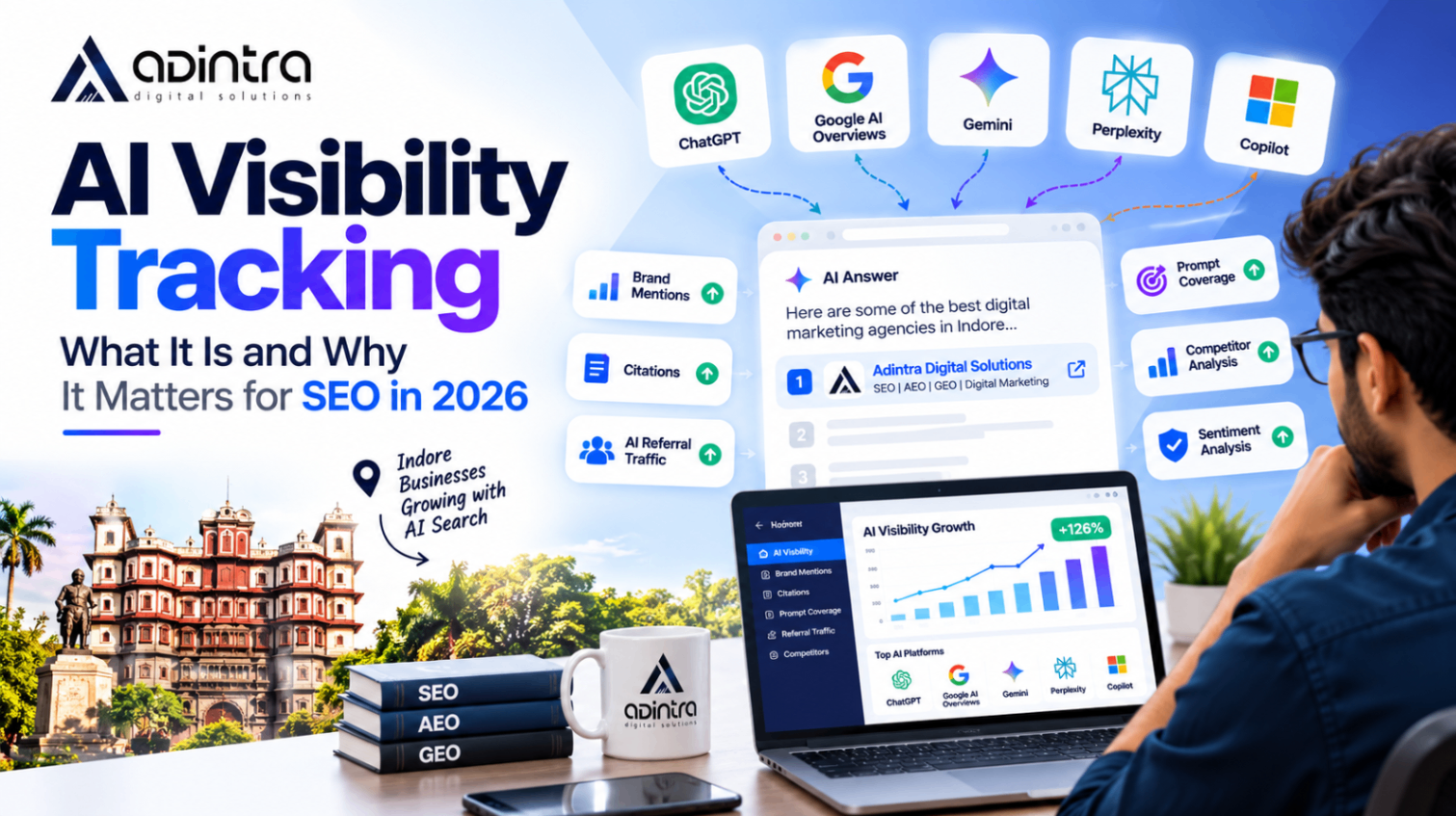
People increasingly use AI-powered tools like ChatGPT, Google AI Overviews, Gemini and Perplexity to find information, compare services and discover brands. Instead of clicking through multiple websites, they may get recommendations directly in an AI-generated answer.
For businesses, this creates a new challenge: your website might rank in search results but remain absent from AI-generated recommendations.
This is where AI visibility tracking becomes important. At Adintra Digital Solutions, we help businesses understand how SEO, AI search visibility and content optimization work together to support long-term online growth.
What Is AI Visibility Tracking?
AI visibility tracking is the process of monitoring how frequently your brand, website and content appear in AI-generated answers across platforms such as ChatGPT, Google AI Overviews, Gemini, Perplexity and Microsoft Copilot.
Traditional SEO focuses on rankings, impressions and organic clicks. AI visibility tracking goes a step further by examining whether AI systems mention your brand, cite your pages or recommend your services for relevant questions.
For example, if someone asks ChatGPT, “What is the best digital marketing agency in Indore?”, you would want to understand whether your business appears in the response and which sources support that recommendation.
The goal is to identify where your brand is visible, where competitors are getting mentioned and what content opportunities you may be missing.
Why Is AI Visibility Important for SEO in 2026?
Search behaviour is changing. Users can now discover information through AI-generated summaries without visiting several websites.
This means businesses should look beyond keyword positions and consider how their content contributes to AI-generated answers.
AI visibility tracking helps you:
Understand when AI platforms mention or cite your brand.
Identify competitors appearing for valuable customer questions.
Discover content gaps that may limit your visibility.
Monitor how AI tools describe your products or services.
Measure referral traffic coming from AI platforms where it can be identified.
For startups, local businesses and D2C brands, these insights can help prioritize content improvements and identify new opportunities to reach potential customers.
What Metrics Should You Track?
A useful AI visibility report should go beyond counting brand mentions. Focus on these five metrics.
1. Citation Share of Voice
Measure how often your brand is cited compared with competitors across a consistent set of relevant prompts. This helps you understand your relative visibility in your industry.
2. Prompt Coverage
Track the customer questions where your business appears. Include branded queries, such as your company name, and non-branded queries, such as “best SEO agency in Indore.”
3. URL-Level Citations
Identify which website pages AI platforms reference most frequently. Your most valuable cited pages might be blog articles, service pages or FAQs rather than your homepage.
4. Brand Description and Accuracy
Check whether AI-generated responses describe your services correctly. Outdated information or missing services can create confusion for potential customers.
5. AI Referral Traffic
Use Google Analytics 4 (GA4), referral reports and suitable UTM tracking where applicable to identify visits originating from AI platforms. This connects visibility insights with website engagement and conversions.
How to Improve Your AI Search Visibility
Improving AI visibility starts with creating useful, accessible and trustworthy content. There is no guaranteed method for getting cited by every AI platform, but several SEO practices can improve your chances of being discovered and understood.
1. Structure Content Around Real Questions
Use descriptive H2 and H3 headings, provide direct answers near the beginning of relevant sections, and include examples that genuinely help readers.
Avoid unnecessary filler. Clear content is easier for users to navigate and easier for search systems to interpret.
2. Build Topical Authority
Create comprehensive pillar pages supported by related articles that answer specific customer questions. Connect these pages through relevant internal links.
For example, a digital marketing agency could publish supporting content about local SEO, technical SEO, GEO, AEO and AI visibility tracking.
3. Strengthen Technical SEO
Ensure your important pages are crawlable, indexable and accessible. Use appropriate structured data, maintain a logical website structure and fix broken internal links.
Schema markup can clarify information about your organization, services and articles, but it does not guarantee AI citations.
4. Demonstrate Experience and Trust
Keep content accurate and updated. Add author information, genuine case studies, credible references and specific examples wherever relevant.
These practices support content quality and help users evaluate your expertise.
Adintra's Four-Step AI Visibility Framework
At Adintra Digital Solutions, our recommended approach focuses on four practical steps:
Audit: Establish where your brand currently appears across selected AI platforms.
Map: Identify the customer prompts and search questions that matter to your business.
Optimize: Improve content structure, topical coverage, internal linking and technical SEO.
Monitor: Review citations, competitor visibility and referral traffic regularly.
A consistent measurement process helps you identify meaningful changes instead of relying on occasional manual searches.
>Improve Your AI Visibility with AdintraSearch is evolving, and businesses need to understand more than traditional keyword rankings. Monitoring how your brand appears in AI-generated answers can reveal new opportunities to improve content, strengthen visibility and reach potential customers.
Want to know where your website stands in AI search? Adintra Digital Solutions helps businesses improve their online presence through SEO, Local SEO, AI SEO, GEO and AEO.
Get a Free AI Visibility Audit and discover opportunities to strengthen your brand's visibility across search engines and AI-powered platforms.
Looking to accelerate your digital growth and search footprint?
Our senior digital architects will audit your SEO visibility, paid ad funnels, and organic growth channels.
FAQs
What is the difference between AI visibility and traditional SEO?
Traditional SEO measures organic search performance, including rankings, impressions and clicks. AI visibility tracking examines brand mentions, citations and recommendations in AI-generated answers.
Do backlinks still matter for AI visibility?
Yes. Backlinks can support website authority and discoverability as part of a broader SEO strategy. However, no single factor guarantees that an AI platform will cite your website.
Which tools track AI visibility?
Specialized AI search monitoring platforms can track citations, brand mentions and prompt-level visibility. Manual prompt testing can also help, although results may vary by query, platform and time.
How often should you track AI visibility?
Monthly monitoring is a practical starting point for many businesses. Highly competitive industries may benefit from more frequent checks.