
Google Ads vs Meta Ads: Which Is Better for Your Business?
Deepak Yadav
Founder
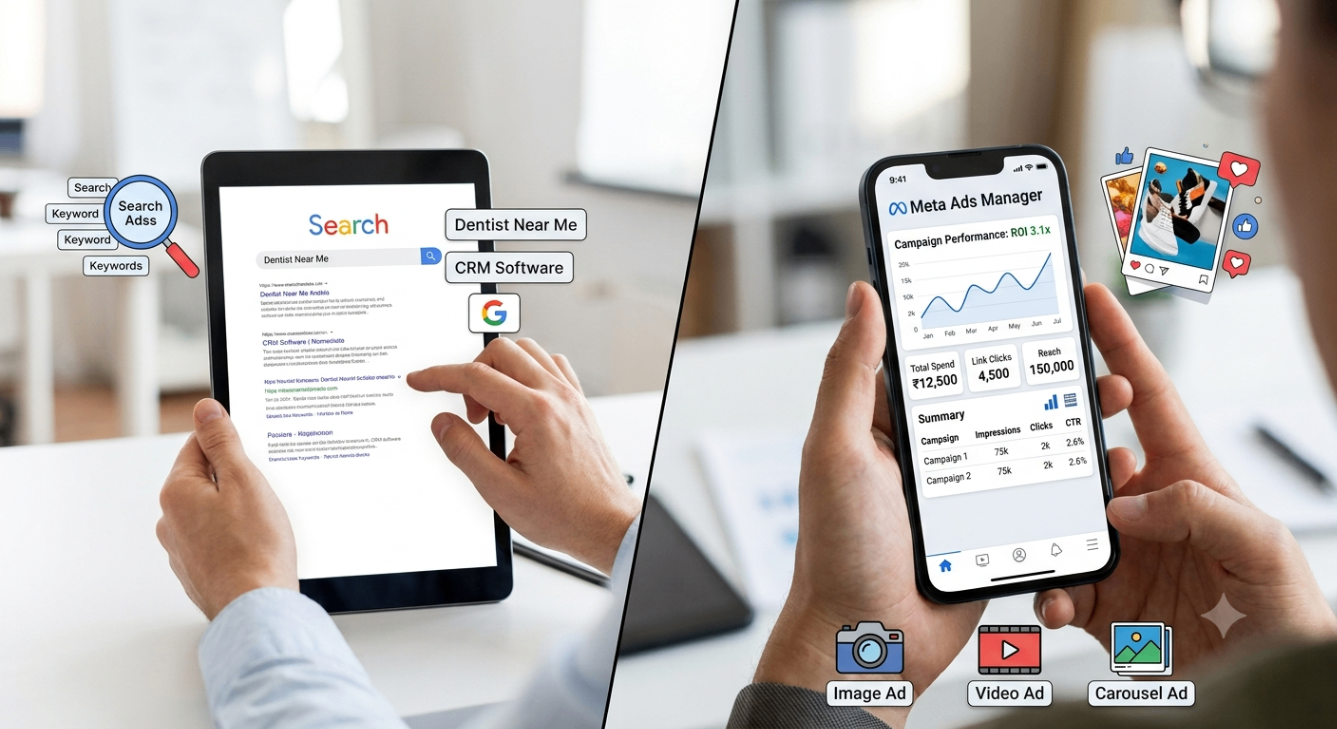
Google Ads vs Meta Ads: Which Is Better for Your Business?
Introduction
Choosing the right advertising platform can make a significant difference to how efficiently a business uses its marketing budget. But when comparing Google Ads vs Meta Ads, there is no single platform that is better for every business.
The right choice depends on customer intent, buying behaviour, industry, location, budget, and conversion goals. Google Ads can help businesses reach people who are actively searching for a product or service, while Meta Ads can introduce products and services to audiences while they browse Facebook and Instagram.
For businesses exploring PPC advertising, understanding this difference is important before allocating a budget. For example, a local company searching for a digital marketing agency in Indore may benefit from capturing existing search demand, while a consumer brand may need visual advertising to create interest first.
Explore Adintra’s PPC Services
Businesses can also evaluate both channels together instead of making an immediate either-or decision. Adintra Digital Solutions helps businesses assess their audience, objectives, location, and campaign requirements before selecting an advertising approach.
Understanding Intent: Google Search vs. Meta Discovery
The biggest difference in Google Ads vs Meta Ads is user intent.
With Google Ads, people often search because they already have a requirement. A user searching for “SEO company in Indore,” “dentist near me,” or “CRM software” is actively looking for a solution. Search advertising can therefore capture existing demand when the right keywords, ads, and landing pages are aligned.
Meta Ads work differently. People generally visit Facebook or Instagram to consume content, connect with others, or discover something new. Advertising can therefore create awareness before a customer has actively searched for a product or service.
This makes Google particularly useful for demand capture, while Meta can be effective for demand generation, discovery, and remarketing. Businesses can also combine both approaches across different stages of the customer journey.
Targeting Capabilities & Audience Reach
Both platforms offer extensive targeting options, but they use different signals.
Google Ads can target search queries, keywords, locations, devices, audiences, and other campaign signals. This can make it useful for businesses with clearly defined services and measurable conversion actions.
Meta Ads provides audience-based targeting across Facebook and Instagram. Businesses can use audience characteristics, interests, behaviours, customer data, and platform signals to reach potential customers.
Creative content is especially important on Meta. Images, videos, testimonials, product demonstrations, and educational content can influence whether someone stops scrolling and engages with an advertisement.
For local businesses, location targeting can also be valuable. A digital marketing agency in Indore, for example, may target customers specifically within Indore rather than spending its entire advertising budget across unrelated locations.
Cost Comparison & ROI Expectations
There is no fixed answer to which platform is cheaper. Advertising costs can change based on industry competition, audience, location, campaign objective, ad quality, seasonality, and conversion rates.
With Google Ads, competitive commercial keywords can have higher click costs because several advertisers may compete for the same search demand. However, users searching for specific services may have stronger purchase intent.
With Meta Ads, businesses can often reach broader audiences based on interests and audience signals. However, because users may not initially be looking for the product, additional nurturing, remarketing, or follow-up may be required.
This is why businesses should not evaluate paid advertising only by CPC or CPM. Metrics such as qualified leads, conversion rate, customer acquisition cost, revenue, and return on ad spend provide a more meaningful picture.
Effective Google Ads management and Meta Ads management should therefore focus on the complete customer journey, from the first interaction to the final conversion.
Which Platform Fits Your Business Model? B2B vs. B2C
B2B Businesses
Google Ads can be a strong option for B2B companies when potential customers actively search for specific solutions. SaaS companies, professional services, technology providers, and specialised service businesses may benefit from high-intent searches.
Meta can still support B2B marketing through awareness campaigns, remarketing, content distribution, and lead-generation campaigns. Its effectiveness depends heavily on audience definition and creative quality.
B2C Businesses
For eCommerce, fashion, beauty, food, fitness, lifestyle, and other consumer businesses, Meta Ads can be useful for product discovery and visual storytelling.
Google Ads can complement this by reaching users searching for specific products, services, brands, or solutions. Shopping and remarketing campaigns can also support customers closer to purchase.
For businesses operating in Indore, combining local search campaigns with social advertising can also help build awareness while capturing customers who are already looking for a solution.
Conclusion
So, which is better in Google Ads vs Meta Ads? The answer depends on where your customers are and what they need before making a purchase.
Choose Google when customers are actively searching for your product or service. Consider Meta when visual discovery, audience building, awareness, or demand generation is important. In many cases, using both platforms can create a more balanced acquisition strategy.
The best approach is not necessarily the platform with the lowest advertising cost. It is the platform—or combination of platforms—that consistently connects marketing spend with qualified leads, sales, and measurable business outcomes.
If your business is deciding between Google and Meta advertising, Adintra Digital Solutions can help you evaluate the right channel mix based on your audience, location, budget, and business goals. Explore its Google & Meta Ads management services or digital marketing services in Indore to understand the available options.
FAQs
1. Is Google Ads better than Meta Ads?
Neither platform is universally better. Google is generally useful for capturing existing search demand, while Meta can be effective for discovery, awareness, and audience-based advertising.
2. Is Google Ads cheaper than Meta Ads?
Not necessarily. Costs depend on industry, competition, audience, location, campaign objective, and conversion performance.
3. Which is better for lead generation, Google Ads or Meta Ads?
Both can generate leads. Google can be effective for high-intent searches, while Meta can generate leads through audience targeting, creative campaigns, and lead forms.
4. Which platform is better for eCommerce?
Both can work well. Meta can support product discovery and visual promotion, while Google can capture product-related searches and purchase intent.
5. Should a small business use Google Ads or Meta Ads?
Start with the platform that matches your customer's buying behaviour. Local and service-based businesses may benefit from Google, while visually driven businesses may find Meta useful.
6. Can I run Google Ads and Meta Ads together?
Yes. Businesses can use Google to capture existing demand and Meta to build awareness, generate interest, and support remarketing.
7. How do I choose the right advertising platform?
Consider your target audience, buying journey, average customer value, competition, budget, creative resources, tracking setup, and conversion goals before choosing a platform.