
LLM SEO: How to Improve Your Brand's Visibility in ChatGPT & AI Search

Nitin Bisen
Co Founder (Root Dev)
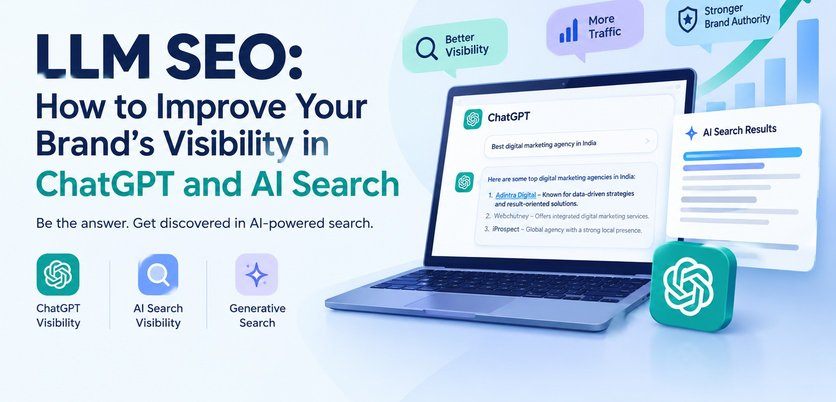
LLM SEO: How to Improve Your Brand's Visibility in ChatGPT and AI Search
If someone searches for your product or service in ChatGPT, Google AI features, Microsoft Copilot, or another AI-powered search experience, will your brand be discovered, mentioned, or cited?
That is the question behind LLM SEO.
LLM SEO is the practice of making your website, brand information, and content easier for AI-powered systems to discover, understand, retrieve, evaluate, and potentially reference when generating answers.
It is closely related to terms such as AI SEO, Generative Engine Optimization (GEO), AI search optimization, and generative search.
But there is an important distinction: there is no guaranteed formula for getting a brand mentioned in ChatGPT or any other AI answer engine. Modern AI search systems use multiple retrieval, ranking, relevance, quality, and freshness signals.
The practical approach is therefore not to "trick" an AI model. It is to build a website and online presence that provides clear, useful, trustworthy, technically accessible information.
Google explicitly says its existing SEO fundamentals remain relevant to AI Overviews and AI Mode. Microsoft likewise states that SEO fundamentals support visibility across Bing, Copilot, and AI-powered search experiences.
This guide explains how LLM SEO works, what you can actually control, and how to build an AI search visibility strategy for your brand.
What Is LLM SEO?
LLM SEO is the process of optimizing a brand's digital presence so that large language model-powered search and answer systems can better discover, understand, retrieve, and reference its information.
Traditional SEO primarily focuses on visibility in search-engine results.
LLM SEO expands the objective toward visibility within AI-generated answers and citations.
For example, traditional SEO might aim to help a website rank for:
"best digital marketing agency in India"
An AI-search-oriented strategy also considers conversational questions such as:
"What should a small business look for when choosing a digital marketing agency in India?"
or:
"Which agencies provide SEO, Google Ads and website development?"
The second type of query requires more than matching a keyword. The system needs to understand:
What the business does
Which services it provides
Where it operates
Who it serves
Whether its claims can be supported
What pages contain relevant information
How trustworthy and useful those pages appear
That is why LLM SEO is not simply putting "ChatGPT SEO" into a webpage repeatedly.
How Does LLM SEO Work?
AI search experiences can use retrieval systems to find relevant information before generating an answer.
Google explains that its generative AI search features can use techniques such as retrieval-augmented generation (RAG) to retrieve relevant information from its Search index and ground AI responses in current web content.
OpenAI also states that public websites can appear in ChatGPT Search and that publishers should avoid blocking OAI-SearchBot if they want their content to be discoverable and potentially included in summaries and citations.
A simplified model looks like this:
User question → Query interpretation → Web/content retrieval → Relevance evaluation → AI-generated response → Supporting sources/citations
This means there are several opportunities for a business to improve its visibility:
Make the website discoverable.
Make important pages crawlable and indexable.
Clearly explain what the business does.
Build comprehensive topical coverage.
Provide useful answers to real customer questions.
Support important claims with reliable sources.
Maintain accurate and consistent business information.
Build legitimate authority across the wider web.
Keep important information current.
Monitor where the brand is being referenced.
None of these guarantees inclusion in an AI answer. They improve the underlying information environment from which search and AI systems can retrieve content.
LLM SEO vs Traditional SEO vs GEO
These terms overlap considerably, but they emphasize different aspects of search.
Approach | Primary focus | Typical objective |
Traditional SEO | Search engines | Improve organic search visibility |
AI SEO | AI-powered search experiences | Improve discoverability in AI search |
LLM SEO | Language-model-powered discovery | Make brand information easier for LLM systems to understand and retrieve |
GEO | Generative engines | Increase the likelihood of being represented or cited in generative answers |
AEO | Answer engines | Structure content around direct questions and answers |
They should not necessarily be treated as completely separate marketing disciplines.
A strong technical SEO foundation, high-quality content, authoritative references, good entity signals, and clear website architecture can support several of these objectives simultaneously.
Microsoft's current Bing Webmaster guidance specifically notes that traditional SEO fundamentals support both conventional search and grounding/citation eligibility in AI experiences.
Why AI Search Visibility Matters for Brands
Search behavior is increasingly conversational.
Instead of searching only:
"SEO agency India"
a prospective customer might ask:
"How can an Indian eCommerce company improve organic traffic and AI search visibility?"
AI systems can potentially synthesize information from multiple sources to answer questions like this.
That creates a different visibility opportunity.
Traditional search visibility
A user sees:
Brand → Search result → Website → User clicks
AI search visibility
A user may see:
Question → AI-generated answer → Brand/source citation → Website
The second path can change how users discover companies.
Importantly, a citation is not the same thing as a ranking, click, conversion, or endorsement.
Bing's AI Performance documentation explicitly distinguishes citation activity from rankings, traffic, clicks, or authority.
Therefore, businesses should measure AI visibility as one component of a broader organic-growth strategy rather than replacing conventional SEO metrics.
How to Improve Your Brand's LLM SEO
1. Build a Strong Technical SEO Foundation
Before worrying about AI search, make sure search engines can actually access and understand your website.
Check:
Crawlability
Indexability
Robots.txt
XML sitemap
Canonical URLs
Internal links
Mobile usability
Page speed
HTTPS
Status codes
Redirects
Structured data
Duplicate URLs
JavaScript rendering
Metadata
Search Console coverage
Google states that pages need to meet its normal technical requirements and be eligible for Google Search before they can appear as supporting links in AI Overviews or AI Mode.
Why this matters for LLM SEO
An AI system cannot reliably use information it cannot retrieve.
Technical SEO is therefore the foundation of AI search visibility.
2. Make Important Content Discoverable
Your most important business information should not be buried.
Create clear pages for:
Products
Services
Industries
Locations
About the company
Contact information
FAQs
Case studies, where genuine
Original research
Guides
Pricing, where appropriate
Policies
Author information
Use descriptive URLs and meaningful internal links.
For example:
Weak architecture
/page1
/services-new
/info2
Clear architecture
/seo-services
/google-ads-ppc
/website-software-development
/ecommerce-marketing
Clear architecture helps both humans and machines understand what each page represents.
3. Create Topic Clusters Instead of Isolated Blog Posts
One of the biggest opportunities in LLM SEO is topical depth.
Suppose your company provides SEO services.
Instead of publishing ten unrelated SEO articles, build a connected knowledge structure:
SEO
→ Technical SEO
→ On-page SEO
→ Local SEO
→ Ecommerce SEO
→ Keyword research
→ Link building
→ Content optimization
→ SEO audits
→ AI SEO
→ LLM SEO
→ Generative search
Each page should answer a specific user need and connect naturally to related content.
This gives your website a clearer topical structure.
Example
A pillar article:
Complete Guide to SEO for Businesses
Could internally link to:
Technical SEO guide
Local SEO guide
Keyword research guide
Ecommerce SEO guide
LLM SEO guide
SEO audit guide
The goal is not to create pages simply to increase page count.
Every page should have a distinct purpose.
4. Answer Specific Questions Clearly
AI search is particularly suited to conversational questions.
Instead of writing:
"Our innovative solutions leverage next-generation digital strategies..."
say:
What is LLM SEO?
LLM SEO is the process of improving a brand's digital content and technical presence so AI-powered search systems can more easily discover, understand, retrieve, and potentially cite that information.
This structure is useful because it provides:
A clear question
A direct answer
Context
Supporting detail
Use question-based content around real customer problems:
What is LLM SEO?
How does ChatGPT search work?
How can my business appear in AI search?
What is Generative Engine Optimization?
Does traditional SEO help with AI search?
How do AI systems find websites?
How can I improve my brand's AI visibility?
What makes content trustworthy for AI search?
Do not create FAQs solely because you believe they will trigger an AI result.
Write questions that your audience genuinely asks.
5. Make Your Brand Entity Easy to Understand
AI systems need to understand not only individual keywords but also entities and relationships.
Your website should make it obvious:
Who are you?
What do you offer?
Who do you serve?
Where do you operate?
What topics do you specialize in?
How can someone verify your information?
For example, Adintra's website identifies the company as a digital marketing agency based in Indore and describes services including SEO, Google and Meta Ads, website development, eCommerce marketing, AEO, GEO, AI SEO and lead generation.
That type of consistent entity description is more useful than repeatedly inserting a company name into unrelated articles.
Keep important business information consistent
Check consistency across:
Website
Google Business Profile
Bing Places
LinkedIn
Business directories
Social profiles
Press coverage
Industry profiles
For local businesses, accurate business information is particularly relevant. Bing recommends maintaining business information through Bing Places so location-related information can remain current for AI-powered experiences.
6. Strengthen E-E-A-T Signals
AI search does not remove the importance of trust.
Your content should make it easy to determine:
Who wrote it
Who reviewed it
What the company does
Where claims came from
When information was updated
Which sources support important statements
Whether examples are genuine
For professional websites, consider adding:
Author information
Include:
Author name
Role
Relevant expertise
Author profile
Editorial transparency
For substantial articles:
Original publication date
Updated date when applicable
References
Editorial/review process
Evidence
Where appropriate, use:
Government sources
Official documentation
Original research
Recognized organizations
Academic publications
Industry documentation
Do not invent credentials, statistics, case studies, awards, or testimonials simply to make a page appear authoritative.
7. Use Structured Data Correctly
Structured data helps search engines understand information on a page.
Depending on the page, relevant schema can include:
Organization
LocalBusiness
Article
BreadcrumbList
Product
Service
Person
FAQPage where applicable
But structured data should accurately represent visible content.
Schema is not a shortcut for AI visibility.
Google says structured data can help it understand page content and potentially support richer search appearances.
The key principle is simple:
Mark up what actually exists on the page.
Do not add misleading schema simply because you want an AI system to interpret your brand differently.
8. Create Original Information, Not Rewritten Information
AI search systems have access to enormous amounts of repetitive content.
Publishing another generic article saying:
"SEO is important because it helps websites rank higher"
does little to differentiate your brand.
Instead, provide something useful:
Original analysis
Practical frameworks
Unique comparisons
First-party observations
Original datasets
Detailed processes
Real examples
Expert-reviewed explanations
Industry-specific recommendations
Microsoft's current webmaster guidance specifically warns against scraped or republished content without added value and emphasizes original, authoritative, useful content.
9. Build Topical Authority Through the Wider Web
Your website is only one part of your digital identity.
AI search systems may encounter your brand across multiple sources.
Relevant signals can include:
Industry publications
Business directories
Professional profiles
News coverage
Partner websites
Industry associations
Reviews
Social profiles
Author profiles
Legitimate backlinks
Third-party references
The objective should not be to create hundreds of low-quality backlinks.
Instead, build a consistent and credible digital footprint.
For example, if a company claims to specialize in healthcare technology, its website, professional profiles, industry references, and published content should collectively support that identity.
10. Optimize Content for Retrieval, Not Just Rankings
Think about how someone would extract information from your page.
A strong page usually has:
Clear heading structure
One obvious topic
Short paragraphs
Descriptive headings
Lists where useful
Tables for comparisons
Definitions
Examples
Relevant internal links
Supporting references
Clear terminology
Compare:
"Our comprehensive ecosystem enables organizations to leverage transformative approaches across multiple operational dimensions."
with:
"LLM SEO helps search systems understand what your business does and which questions your content can answer."
The second sentence is easier to understand.
Clarity is an SEO asset.
Bing's current guidance specifically recommends clear, focused, useful content and notes that structured content can improve interpretation and grounding reliability.
11. Keep Important Information Fresh
AI-generated answers can depend on information that has changed.
Review pages containing:
Pricing
Product specifications
Service offerings
Business hours
Team information
Contact details
Regulations
Technology documentation
Statistics
Industry trends
Don't change dates simply to make old content look new.
Update an article when its substance has actually changed.
Bing's AI Performance guidance notes that citation patterns can change due to factors including content updates, user demand, and system/model changes.
12. Make Sure AI Crawlers Can Access Your Content
For ChatGPT visibility specifically, this is an important technical consideration.
OpenAI's publisher documentation states that public websites can appear in ChatGPT Search and recommends ensuring that OAI-SearchBot is not blocked if publishers want content to be discoverable, surfaced, and clearly cited or linked.
Check your:
robots.txt
and understand which crawlers your website permits.
However, crawler access is not a guarantee of citation or inclusion.
It simply removes one potential technical barrier.
13. Don't Ignore Bing
AI search visibility isn't limited to ChatGPT or Google.
Microsoft's current Bing Webmaster Tools includes an AI Performance report that can show:
Pages cited in AI answers
Citation activity
Average cited pages
Grounding queries
Page-level citation activity
The feature covers supported AI experiences including Microsoft Copilot and AI-generated summaries in Bing.
This is particularly useful because it moves AI visibility measurement from pure speculation toward observable citation data.
It still does not tell you why a particular page was selected or guarantee future citations.
14. Use Internal Links to Build Context
Internal links aren't just navigation.
They help establish relationships between topics.
For example:
LLM SEO
→ Technical SEO
→ Content SEO
→ Entity SEO
→ AI SEO
→ Local SEO
→ Content strategy
A page discussing LLM SEO can naturally link to a technical SEO service page.
Similarly, an article about AI search can link to a broader SEO guide.
This creates a connected information architecture instead of a collection of isolated articles.
15. Optimize for the Full User Journey
A user may discover your brand through an AI answer but eventually visit your website.
That means the destination matters.
Your landing page should answer:
What do you do?
Who do you help?
Why should someone consider you?
What services/products do you provide?
Where do you operate?
How can someone contact you?
What evidence supports your claims?
For Adintra, the existing website already presents SEO, Google and Meta Ads, website development, eCommerce marketing, AI SEO and related services as part of its broader digital marketing offering.
Your content strategy should reinforce that same positioning rather than creating contradictory descriptions across different pages.
A Practical LLM SEO Strategy
If you're starting from scratch, use this sequence.
Step 1: Audit your technical foundation
Check:
Indexing
Robots.txt
Sitemap
Canonicals
Mobile experience
Page speed
Broken links
Redirects
HTTPS
Structured data
Step 2: Define your brand entity
Document:
Company name
Services
Products
Locations
Target customers
Industries
Areas of expertise
Key people
Contact details
Step 3: Map search questions
Create a list of questions your customers ask before purchasing.
Group them into:
Informational
Commercial
Transactional
Local
Comparison
Problem-solving
Step 4: Build topical clusters
Create pillar pages and supporting articles around your most important topics.
Step 5: Improve existing content
Prioritize pages with:
High business value
Existing search visibility
Weak content
Outdated information
Strong conversion potential
Step 6: Add evidence
Support important claims with credible sources and first-party information.
Step 7: Strengthen entity consistency
Ensure your website and important third-party profiles describe your company accurately.
Step 8: Build legitimate authority
Earn relevant mentions, references, links, partnerships, and industry coverage.
Step 9: Monitor AI visibility
Check relevant AI search experiences periodically and use available webmaster tools, including Bing's AI Performance reporting where applicable.
Step 10: Improve based on evidence
Don't change content simply because an AI answer didn't mention you once.
AI responses can vary based on query wording, retrieval, location, freshness, system changes, and other factors.
Look for patterns over time.
Common LLM SEO Mistakes
Mistake 1: Stuffing "ChatGPT" into every paragraph
Using:
ChatGPT SEO
ChatGPT visibility
ChatGPT ranking
ChatGPT optimization
repeatedly does not create useful content.
Write naturally.
Mistake 2: Creating hundreds of AI-generated pages
Large-scale content without meaningful editorial oversight can produce repetitive, inaccurate, or low-value pages.
Microsoft explicitly warns against automatically generated content at scale when it lacks quality, originality, or useful value.
Mistake 3: Treating AI search like a ranking system with one formula
There isn't a universal:
"Do X → get cited by ChatGPT"
formula.
Different AI products can use different models, retrieval systems, indexes, sources, and ranking processes.
Mistake 4: Ignoring traditional SEO
This is one of the biggest misconceptions.
Google explicitly says its existing SEO practices remain relevant for AI Overviews and AI Mode.
Technical SEO still matters.
Content quality still matters.
Crawlability still matters.
Links still matter.
Search intent still matters.
Mistake 5: Publishing unsupported claims
Statements such as:
"We are India's #1 agency."
or:
"Our strategy guarantees AI citations."
are not strengthened merely by repeating them.
If a claim matters, provide evidence or phrase it appropriately.
Mistake 6: Confusing visibility with business results
A brand mention can be valuable, but it doesn't automatically mean:
Website traffic
Leads
Sales
Revenue
Brand preference
Measure AI visibility alongside conventional business metrics.
How Should You Measure AI Search Visibility?
Traditional SEO reporting might include:
Organic impressions
Organic clicks
Rankings
CTR
Conversions
Organic revenue
AI search adds another layer.
Consider monitoring:
Brand mentions
Is your company appearing in relevant AI answers?
Citations
Are your pages being used as supporting sources?
Citation URLs
Which pages are being referenced?
Query themes
What kinds of questions are associated with your content?
Referral traffic
Are AI platforms sending visitors to your website?
Conversion quality
Do those visitors generate meaningful enquiries, purchases, or other business outcomes?
Bing's AI Performance reporting is particularly relevant because it exposes cited URLs and grounding-query information for supported AI experiences.
LLM SEO Example for a Digital Marketing Agency
Imagine a digital marketing agency wants to become more visible for:
"digital marketing agency for small businesses in India"
A weak strategy would create one article repeating the keyword.
A stronger strategy could create a content ecosystem:
Core service pages
SEO Services
Google Ads Management
Meta Ads
Website Development
eCommerce Marketing
AI SEO / LLM SEO
Educational content
What is LLM SEO?
SEO vs AI SEO
How Google AI search works
How to improve AI search visibility
Technical SEO checklist
Local SEO guide
Content strategy for AI search
Commercial content
How to choose an SEO agency
SEO agency pricing considerations
SEO services for small businesses
AI search optimization services
Supporting authority
Original research
Industry analysis
Detailed guides
Expert-reviewed content
Genuine client work where permission and evidence exist
The result is not simply "more content."
It is a clear information ecosystem around the business's expertise.
Does LLM SEO Replace Traditional SEO?
No.
LLM SEO should be treated as an extension of a broader search and content strategy rather than a replacement for SEO.
Google's documentation explicitly states that foundational SEO remains relevant to its AI search experiences.
A practical strategy therefore looks like:
Technical SEO
High-quality content
Topical authority
Entity clarity
Structured information
Digital authority
AI-search monitoring
Rather than:
"Write articles for ChatGPT."
The Future of LLM SEO
AI search is still evolving.
Google's AI Overviews and AI Mode, ChatGPT Search, Microsoft Copilot and other AI experiences can change how information is retrieved, synthesized, and presented.
That means today's optimization tactics should not be treated as permanent rules.
The more durable strategy is to build a website that is:
Accessible
Useful
Original
Well structured
Technically sound
Evidence-based
Topically relevant
Entity-consistent
Regularly maintained
This approach also benefits conventional search, users, and conversion journeys.
The direction of search is changing, but the underlying principle remains remarkably stable:
Make your information easy to discover, understand, verify, and use.
Final Takeaway
LLM SEO is not about manipulating ChatGPT into mentioning your company.
It is about building a digital presence that AI-powered search systems can confidently discover and understand.
Start with the fundamentals:
Make your website technically accessible.
Create genuinely useful, original content.
Answer real customer questions directly.
Build comprehensive topical coverage.
Make your brand and expertise easy to understand.
Use structured data accurately.
Strengthen legitimate authority across the web.
Keep important information accurate and current.
Monitor AI citations and search visibility where data is available.
Continue improving based on evidence rather than assumptions.
For businesses investing in SEO today, AI search visibility should be considered alongside traditional organic search—not instead of it.
If your website needs a broader strategy covering SEO, AI SEO, AEO, GEO, LLM SEO, technical SEO, content, and website performance, Adintra Digital Solutions provides these capabilities as part of its broader digital marketing offering.
INTERNAL LINKING RECOMMENDATIONS
Based on the currently indexed Adintra website, these are relevant internal linking opportunities:
Anchor Text | Suggested Target Page | Why It Is Relevant |
SEO Services | /seo-services | Links the LLM SEO article to Adintra's broader SEO offering. |
Digital Marketing Services | /services | Connects the educational article to the complete digital marketing service offering. |
Website Development | /website-software-development | Relevant when discussing technical SEO, crawlability, website architecture, speed and mobile experience. |
Google Ads & PPC Management | /google-ads-ppc | Useful for explaining the difference between organic AI visibility and paid acquisition. |
SEO Services in Indore | /blog/seo-services-in-indore | Relevant supporting content for readers who want broader SEO information. |
Frequently Asked Questions | /faq | Useful for users looking for additional SEO and digital marketing questions. |
Recommended internal-link placement: Add 4–6 contextual links throughout the article rather than putting all links in one section.
EXTERNAL SOURCES
1. OpenAI — Publishers and Developers FAQ
OpenAI explains how public websites can appear in ChatGPT Search and specifically discusses OAI-SearchBot, crawler access, summaries and citations.
OpenAI Publishers and Developers FAQ
2. Google Search Central — AI Features and Your Website
Google explains that standard SEO fundamentals continue to apply to AI Overviews and AI Mode, and describes technical eligibility for appearing as supporting links.
Google: AI Features and Your Website
3. Google Search Central — Optimizing for Generative AI Features
Useful for the sections discussing RAG, AI search, SEO fundamentals, and people-first content.
Google: Optimizing Your Website for Generative AI Features
4. Bing Webmaster Tools — AI Performance
Supports the discussion of AI citations, grounding queries, cited URLs, and measurement of visibility in supported Microsoft AI experiences.
Bing Webmaster Tools: AI Performance
5. Bing Webmaster Guidelines
Supports recommendations around crawlability, sitemaps, content quality, structured information, originality, and avoiding manipulative AI-search tactics.
IMAGE RECOMMENDATIONS
Placement | Image Concept | Purpose | SEO-Friendly Alt Text |
After introduction | Diagram showing traditional search vs AI search | Explain the fundamental difference visually | LLM SEO comparison between traditional search and AI search visibility |
After "How Does LLM SEO Work?" | Flow diagram: Query → Retrieval → Sources → AI Answer | Explain retrieval and grounding | How LLM SEO content is retrieved and referenced in AI search |
After "Traditional SEO vs GEO" | Comparison graphic | Help readers understand terminology | Traditional SEO versus LLM SEO and generative engine optimization |
After strategy section | 10-step LLM SEO framework | Make the process actionable | LLM SEO strategy framework for improving AI search visibility |
Measurement section | AI visibility dashboard mockup | Explain citations and monitoring | AI search visibility and citation monitoring dashboard |
Conclusion | Brand ecosystem diagram | Reinforce website + content + authority concept | Brand digital ecosystem for LLM SEO and AI search visibility |
Image guidance: Keep diagrams genuinely useful. Do not turn every heading into an image, and do not put essential information only inside graphics. Bing specifically recommends that images and video reinforce the primary text rather than being the sole source of information.
FAQS
1. What is LLM SEO?
LLM SEO is the practice of improving a brand's website and digital presence so AI-powered search systems and language-model-based experiences can more easily discover, understand, retrieve and potentially reference its information.
2. How can I improve my brand's visibility in ChatGPT?
Start with technical SEO and crawlability, create useful original content, clearly explain your brand and services, answer relevant questions, build authoritative references across the web, and ensure important pages are accessible to relevant crawlers. OpenAI specifically recommends avoiding blocking OAI-SearchBot if you want website content to be discoverable in ChatGPT Search.
3. Is LLM SEO different from traditional SEO?
LLM SEO focuses more explicitly on AI-powered discovery, retrieval and citations, while traditional SEO focuses primarily on organic search visibility. However, the two overlap substantially. Google and Bing both state that foundational SEO practices remain important for their AI-powered search experiences.
4. Can I guarantee that ChatGPT will mention my business?
No. There is no reliable method that guarantees a brand will be mentioned or cited in every relevant AI response. AI systems can use different retrieval systems, models, sources and query interpretations.
5. Does traditional SEO help with AI search?
Yes. Traditional SEO practices such as crawlability, indexability, useful content, clear site architecture and relevant authority remain important. Google explicitly states that its foundational SEO best practices apply to AI Overviews and AI Mode.
6. What is Generative Engine Optimization (GEO)?
GEO generally refers to optimizing content and digital information for visibility within generative AI and answer-engine experiences. It overlaps significantly with AI SEO and LLM SEO, although terminology and specific practices vary across the industry.
7. How do I measure AI search visibility?
Depending on the AI platform, measurement can include brand mentions, cited pages, citation frequency, referral traffic and conversions. Bing Webmaster Tools now provides AI Performance reporting for supported Microsoft AI experiences, including cited URLs and grounding queries.
8. Does adding an FAQ section automatically improve LLM SEO?
No. FAQs can make genuine user questions easier to understand and navigate, but simply adding large numbers of questions does not guarantee AI visibility. The questions and answers should be useful, accurate and relevant to the page's subject.